
Mastering Rendering Methods in Next.js 🧠⚡

✨ Mastering Rendering Methods in Next.js
Learn how Next.js lets you choose the best rendering approach for your page — with performance, SEO, and user experience in mind.
✨ Introduction
Next.js is a powerful React framework — but what truly sets it apart is how flexibly it handles rendering. Whether you want blazing-fast static pages, dynamic server-rendered data, or a mix of both, Next.js has a rendering method for you.
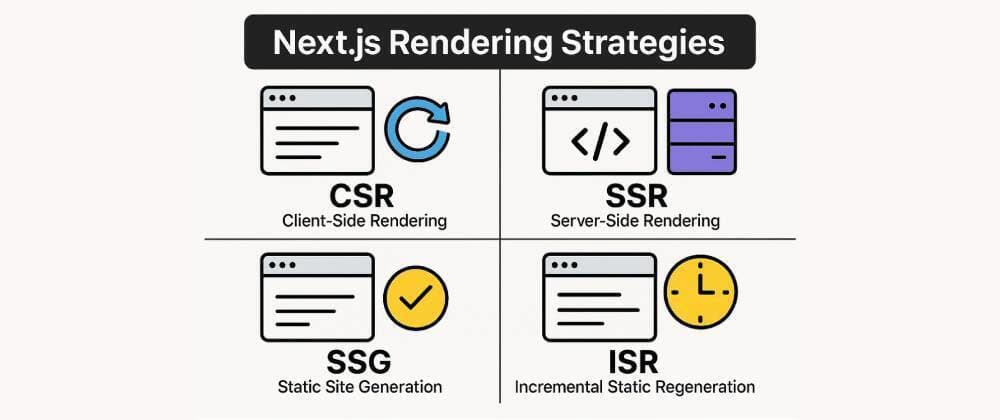
In this post, we’ll explore:
- 🌀 Client-Side Rendering (CSR)
- 🌐 Server-Side Rendering (SSR)
- 📦 Static Site Generation (SSG)
- 🔄 Incremental Static Regeneration (ISR)
- ⚡ Hybrid Rendering
- 🧪 Streaming and Server Components
🌀 1. Client-Side Rendering (CSR)
The HTML is sent empty. Your browser does all the work using JavaScript.
✅ Great for: Authenticated dashboards, user-specific pages, apps without SEO needs.
'use client'

export default function Dashboard() {
  const [data, setData] = useState(null)

  useEffect(() => {
    fetch('/api/data')
      .then(res => res.json())
      .then(setData)
  }, [])

  return <div>{data ? data.name : 'Loading...'}</div>
}
🧠 Pros: Interactive, lightweight initial build ⚠️ Cons: Poor SEO, slower first render
🌐 2. Server-Side Rendering (SSR)
Every time a user requests the page, the server builds the HTML in real-time.
✅ Great for: Search pages, personalized content, SEO-critical pages
export async function getServerSideProps(context) {
  const res = await fetch('https://api.example.com/data')
  const data = await res.json()
  return { props: { data } }
}
🧠 Pros: Fresh data, SEO-friendly ⚠️ Cons: Slower performance, depends on server response time
📦 3. Static Site Generation (SSG)
The HTML is built once at build time. Fast and reliable!
✅ Great for: Blogs, marketing pages, documentation, landing pages
export async function getStaticProps() {
  const res = await fetch('https://api.example.com/posts')
  const posts = await res.json()
  return { props: { posts } }
}
🧠 Pros: Super-fast, globally cached ⚠️ Cons: Data can become stale
🔄 4. Incremental Static Regeneration (ISR)
Regenerate static pages after deployment without rebuilding the whole site.
✅ Great for: News articles, product listings, event pages
export async function getStaticProps() {
  const res = await fetch('https://api.example.com/events')
  const events = await res.json()
  return {
    props: { events },
    revalidate: 60,
  }
}
🧠 Pros: Combines speed and freshness ⚠️ Cons: Slight delay before changes are visible
⚡ 5. Hybrid Rendering
Mix and match rendering methods on a per-page basis.
✅ Great for: Real-world apps with mixed needs
// blog/[slug] → SSG
// profile → SSR
// dashboard → CSR
🧠 Pros: Best of all worlds ⚠️ Cons: Needs careful planning
🧪 6. Streaming & Server Components (App Router)
With the App Router, Next.js uses React Server Components and supports streaming for faster performance and less JS.
✅ Great for: Modern apps needing performance and minimal JS
// app/posts/page.jsx
export default async function PostsPage() {
  const posts = await getPosts()
  return <PostsList posts={posts} />
}
🧠 Pros: Lightweight pages, performance gains ⚠️ Cons: Requires App Router + React 18
📊 Comparison Table
| Method | SEO | Speed | Freshness | Best For |
|---|---|---|---|---|
| CSR | ❌ | ⚠️ | ✅ | Dashboards |
| SSR | ✅ | ⚠️ | ✅ | Search, Auth pages |
| SSG | ✅ | ✅ | ❌ | Blogs, Docs |
| ISR | ✅ | ✅ | ✅ | News, E-commerce |
| RSC | ✅ | ✅ | ✅ | Modern, large apps |
🔚 Final Thoughts
The real power of Next.js is in choosing the right tool for the job. Whether you want pre-rendering at build time or real-time data for every request, Next.js gives you full control.
🧠 "Use SSG when you can, SSR when you must, CSR when it makes sense."

Muhammad Hamid Raza
Content Author
Originally published on Dev.to • Content syndicated with permission